
Ivan Margary’s System For Numbering Roads
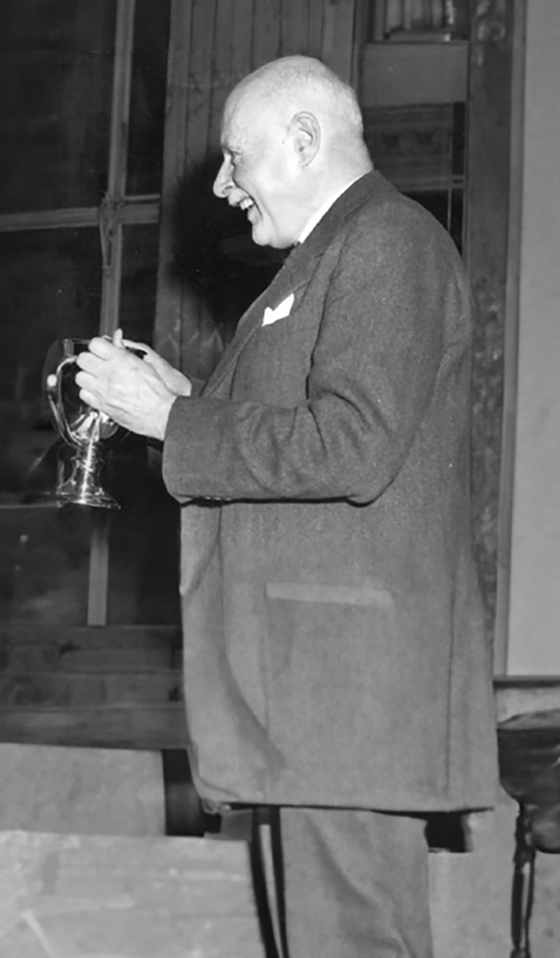
When Ivan Margary compiled his magnum opus, Roman Roads in Britain (1955), he needed a means of easily cross-referencing the 355 roads he describes in the book.
Tell Me About
Margary’s Numbering System
Accordingly, he created a system of numbering Roman roads based upon the modern road numbering system devised by the Government’s Roads Board in 1913. Margary had no notion that his system would rapidly become the standard method of reference for Roman Roads by scholars and the public alike. The following is Margary’s own description of his system taken from the Introduction to his book:
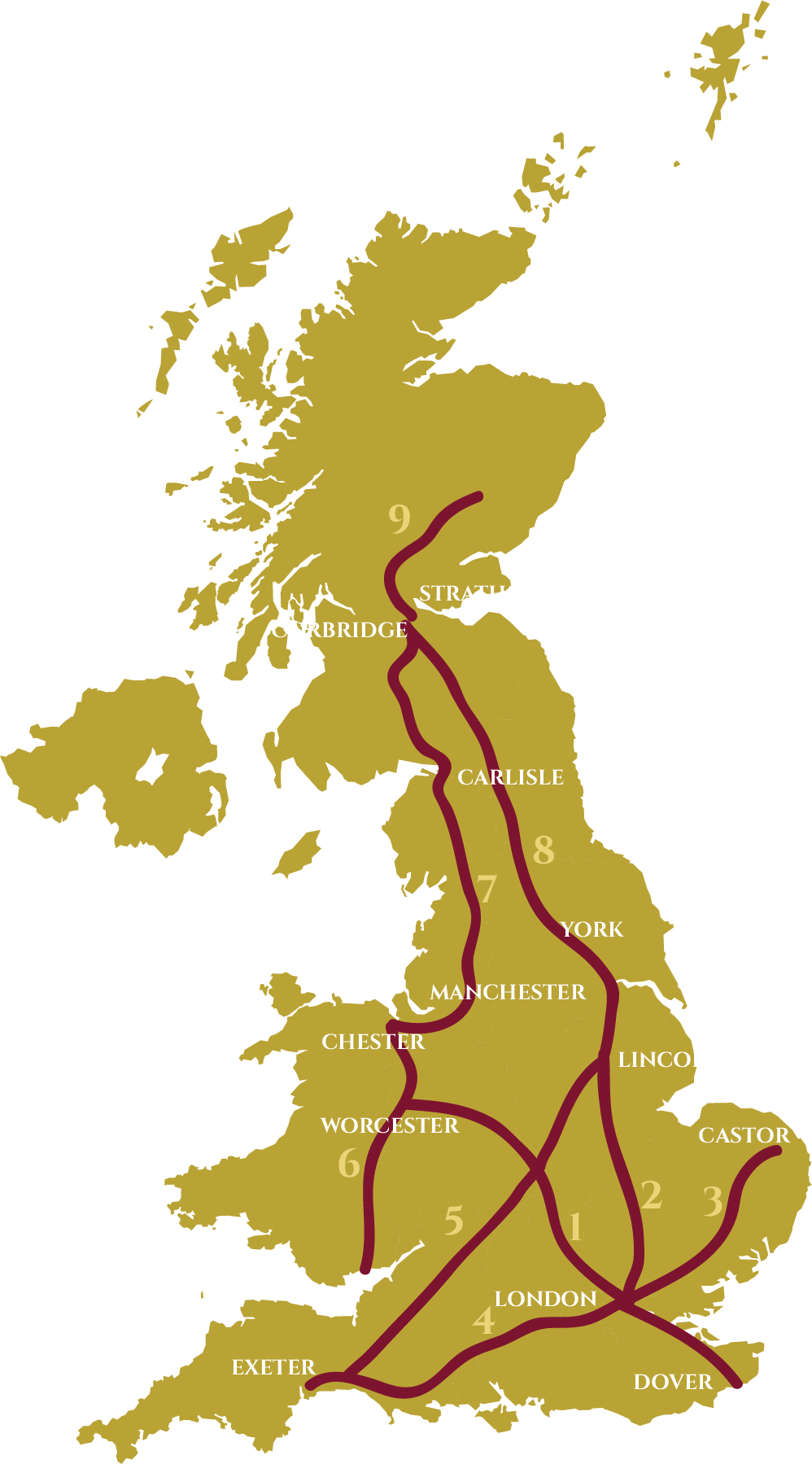
“Single digit numbers are given to the main routes thus: 1 Watling Street, 2 Ermine Street, 3 London to Colchester and Norwich, 4 London to Exeter, 5 Foss Way, 6 Watling Street (West) in the Welsh Marches, 7 the western main north route through Carlisle, 8 the eastern main north route through Corbridge, and 9 the northern road from the Scottish Roman Wall to Strathmore.
The principal branches from each of these have a two-digit number, 40, 41, 42 …, working as far as possible consecutively along the main route, and then the minor branches are given three-digit numbers related to the nearest two-digit branch available. Thus a road numbered 421 will be readily identified as a branch somewhere near road 42 (Silchester—Winchester), itself a branch from the south-western main route 4. Then road 40 will be found as a branch of road 4 in London, but 47 is a branch at Dorchester and 49 at Charmouth, nearer the western extremity of road 4. Where it has been found necessary to divide the account of the longer roads into several portions these are indicated by adding the letters a, b, etc., after the number.”
Margary’s Numbering System
Moving Forwards
Margary’s numbering system has now been in use for over 60 years and is so well established that it seems likely to continue as the main referencing system. However, since Ivan Margary died in 1976, his numbering system has become effectively frozen leaving all the “new” Roman roads discovered since outside his system. This has been further complicated by the Ordnance Survey Archaeology Division’s use of ‘X’ numbers (usually written ‘RRX’) for any suspected Roman roads which they recorded. The Royal Commission on the Ancient and Historical Monuments of Wales uses its own system awarding RRN and RRZ numbers to its newly discovered Roman roads. Both these systems awarded numbers successively as roads were added to the record, and neither system can integrate into Margary’s method. Many recently discovered roads have no number at all.
Clearly, the current situation is chaotic and confusing and is only going to get worse as more roads are discovered, especially as the use of new technologies such as LiDAR has increased the speed of discovery.
This complex and difficult numbering issue was discussed by Participant Groups at our Ivan D Margary Memorial Conferences in Portsmouth and York in 2016. The overarching conclusion was that that RRRA should take the lead and re-start Margary’s system from where he left it in 1976 and this work has already started.
As each region in Britain is incorporated into our gazetteer, all newly discovered roads and ones with an RRX or RRN number confirmed as being of Roman origin will be given a unique Margary number. All the roads we add to Margary’s system will bear the suffix ‘(x)’ to distinguish them from the roads awarded numbers by Margary himself. So, for example, the road from Lancaster which extends Margary’s RR70e northwards to Ambleside, has been given the number RR70f(x). We use the prefix RR (for Roman Road) since this is in general use amongst most heritage organisations such as Historic England, RCAHMW and Historic Environment Scotland. Currently, some individuals and groups use ‘M’ or ‘Margary’ as a prefix to Roman road numbers, although it is hoped that ‘RR’ will become the generally accepted descriptor, as Margary himself preferred.