
Digitised Map & Gazetter
Work on the Gazetteer started in 2016 and has been launched with the Yorkshire Region, compiled by Mike Haken, which covers some 964 miles of Roman roads, over 10% of the British network. We will proceed one region at a time with the North West region to follow next.

Navigating
The Gazetteer
The entry for each road provides you with: a route map, links to relevant online data sources e.g. HER and Pastscape, Margary’s full text for the road (if he wrote one), link to RRRA discussion forum for the road, and an illustrated summary and analysis of historic and recent research with a description of the route as it is currently understood.
Some roads outside a region, but heading into it, are therefore relevant and included in the regional lists so, for example, in Yorkshire, RR2d and RR28a in Lincolnshire are included because they were built as part of routes entering the territories of the Parisi and the Brigantes, the area we now call Yorkshire.
The gazetteer has been designed to stand alongside an interactive map, currently being developed, which will allow you to view a highly detailed online map of all the known and suspected Roman roads in Britain.
Including:
https://roadsofromanbritain.org/northwest.html
https://roadsofromanbritain.org/yorkshire.html
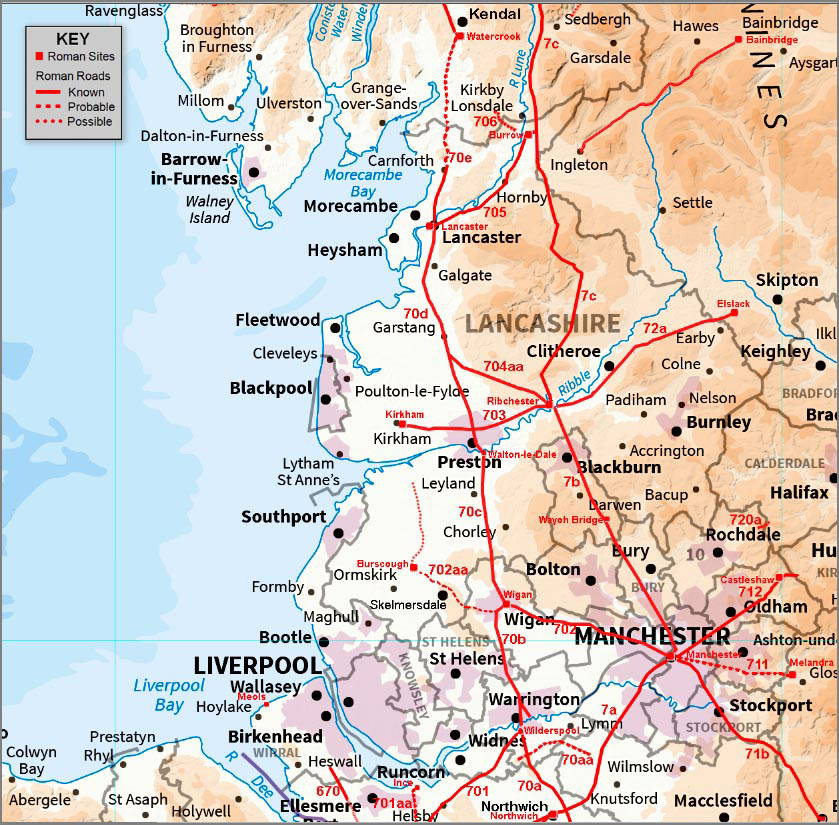
The pages have been updated for 2018 – possibly the biggest update in 20 years! The roads have now been split into individual Margary sections but have been grouped together as before. The opportunity was taken to expand the amount of information provided for virtually every road but especially so in the Greater Manchester area. This includes new suggestions as to where the roads were set-out from, deduced from 3D Lidar virtual reality models and new contour mapping.
What is remarkable is how our Roman road map has now been filled in with many puzzling gaps eliminated. The biggest outstanding issue is the Manchester to Melandra where there are two options and not high confidence ones at that.
NEWS UPDATE: But just when everything seemed to have been sorted out then a new fort has popped up with probably 2 associated roads. The long suspected fort at Burscough has now been confirmed by excavation (Stephen Baldwin, CBA NW Conference, 2018) and by geophys (Wigan AS, Bill Aldridge). However, as the site is currently unlisted and therefore unprotected, its precise position has been requested to be kept secret. It is hoped that this will be resolved soon but until then I have not included Lidar images of the fort or the roads immediately adjacent to it.
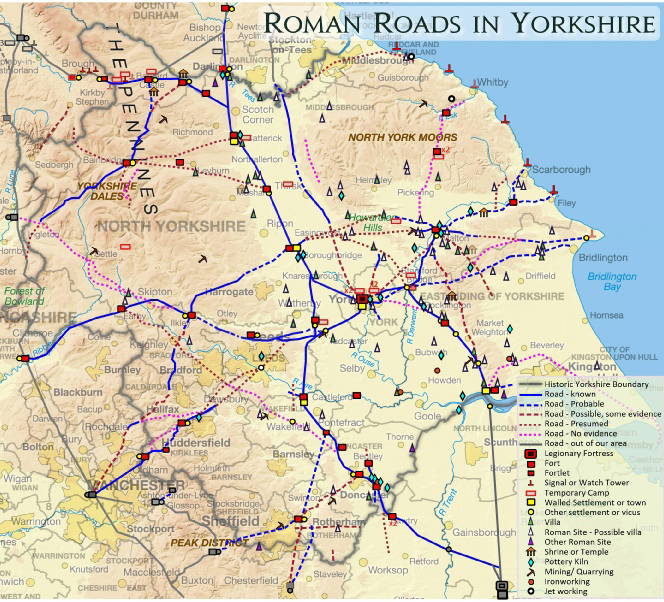
The map above is interactive – simply click on any road to bring up a detailed and illustrated summary. Hovering over military sites and settlements (the red and yellow icons) will also bring up their labels. Alternatively, scroll down this page for a list of all the known and probable Roman roads in Yorkshire – each road name is clickable and will bring up it’s gazetteer entry. With a county of such a size, it is no surprise that there are 51 entries , although we have also included RR2d and RR28aa in Lincolnshire, roads whose sole function was to access the territories of the Parisi and the Brigantes, the two late Iron Age tribal territories that make up modern Yorkshire.
The numbering system used is that originally developed by Ivan Margary in the mid 20th century, which provides a consistent form of identification. To accommodate roads identified after Margary’s death in 1976, we have continued to use his system but have added an (x) suffix. Numbers bearing the prefix RRX were awarded by the Ordnance Survey’s Archaeological Division who (for reasons best known to themselves) did not follow Margary’s logical numbering system: wherever such roads have been proven to be of Roman origin they have now been awarded numbers using Margary’s original system with the (x) suffix.
To give some historical background to this work, there is an overview of the work of the many antiquaries and researchers who have made contributions to our understanding of the Roman road network in Yorkshire over the last five decades, and this can be accessed via the “Previous Research in Yorkshire” button above.
All entries are the work of Mike Haken, although many thanks are due to Jayne Knight for editing the draft text, a not inconsiderable task. I must also thank some of the many individuals who have contributed, assisted and advised over the many years it has taken to compile these entries, in particular the late Hugh Toller, David Ratledge, Bryn Gethin, Pete Wilson, John Poulter, Olly Cooper, and the staff at Yorkshire’s many HERs.