
The Antonine Itinerary
The itinerary of the Emperor Antoninus, or the “Itinerarium Provinciarum Antoni(ni) Augusti”, to give its full Latin title, is a collection of 225 lists of stopping places along various Roman roads across the Roman Empire
Iter Britainnarium
The Antonine Itinerary
The British routes are at the end of the land itinerary. Following the end of the land itinerary is the Imperatoris Antonini Augusti Itinerarium Maritimum, which gives a few sea routes and a list of small islands.
Its value, especially for Britain, comes from it being one of a very few documents to have survived to modern times which provide detail of names and clues to location of Roman sites and the routes of roads. Each list, or Iter, gives the start and end of each route, with the total mileage of that route, followed by a list of intermediate points with the distances in between. They do not cover every Roman road; in Britain they utilise less than 25%. They cannot even be said to focus on the most important roads. Furthermore, some stretches of road appear as part of several itineraries so, for example, the road usually referred to these days as Dere Street, between Catterick and York, forms part of Iters I, II & V.
There are at least five primary manuscripts from which published texts are drawn, and it is generally agreed that they all probably derive from the ‘Codex Spirensis’ which was copied between AD 1427 and 1551 (Reed, 1978, p. 228). How many times they were copied and re-
Thanks to its title, the Itinerary has often been ascribed to the Roman emperor Antoninus Pius (ruled 138 – 161) but it is clear that this cannot be the case. The British section, crucially, is headed “Iter Britanniarum”; Britanniarum is plural, indicating that the collection was put together after Britain was divided into two provinces by Septimius Severus c.197 A.D. (Rivet & Smith, 1979, p. 154). Indeed, it is likely that the collection was actually written over almost two centuries, the earliest seeming to be the maritime route from Rome to Arles compiled before AD 107 (Reed, 1978), with the majority written much later, with one at least as late as AD 284 containing the place-
Distances in the Itinerary are generally measured in miles, written as m.p. (mille passus) that is to say 1000 paces (full paces – ie two steps) of five pedes (feet) each. The standard Roman foot appears to have been 11.65 inches (296mm), based upon the measurement of it on the tombstone of T. Statilus Aper, a mensor aedificiorum in Rome, and by the length of several foot-
The function of the Itinerary, either as individual routes or as a collective work, is far from clear, with opinions ranging from them representing routes of the Cursus Publicus (in effect the Imperial postal service) to their being routes of journeys planned for emperors or their armies. The most plausible explanation came from Nicholas Reed, who argued that the Itineraries are a collection of routes to be used for the collection of annona militaris, a tax of food and supplies originally imposed by Septimius Severus to provide for the Roman Army (Reed, 1978, p. 244). Casado sums this up perfectly “This would explain the arbitrary way in which the routes contained in the document were selected, and would also account for the strange “detour-
Perhaps the biggest issue with the Itinerary is the large number of apparent errors, mainly in its mileage figures; a precise geographical document it is not. Logically, these errors fall into two groups, those of transmission ie errors made by scribes when copying and those in the original work (Rivet, 1970, p. 37). Some of the copying errors are obvious, for example missing stages as in Iter II of the British section where some twenty miles are missing between York and Manchester. Setting these on one side and focussing on apparent errors in the original, it can be seen that most of the errors are quite small. Of the 141 stages in the British section examined by Rivet in his 1970 analysis, after correcting for probable scribal error (Rivet, 1970, p. 38), 54 appeared to be correct, with 17 having too great a distance and a massive 70 having too short a distance, 39 being of these being of two miles or more. It is conceivable that the bulk of the 41 errors that are one mile either way may be caused by minor errors of measurement, or by rounding off (distances are given in whole miles). However the consistent and unexplained shortfall in nearly all the others suggests that there is a fundamental cause.
One possibility is that not all distances were measured from the centre of a town or fort, rather they might have been measured from an outer boundary, or “town zone” (Rodwell, 1975). This suggestion was countered by Mann, who suggested that it might have arisen from the difficulties experienced by Rome in enforcing standard units of measurement, with a longer mile perhaps being used in southern Britain and North-
Whatever the actual cause of the apparent errors in the original work, debate will no doubt continue for a very long time to come. In the production of the accounts of each Iter, I have endeavoured to provide the most plausible explanation for transmission errors in each case.
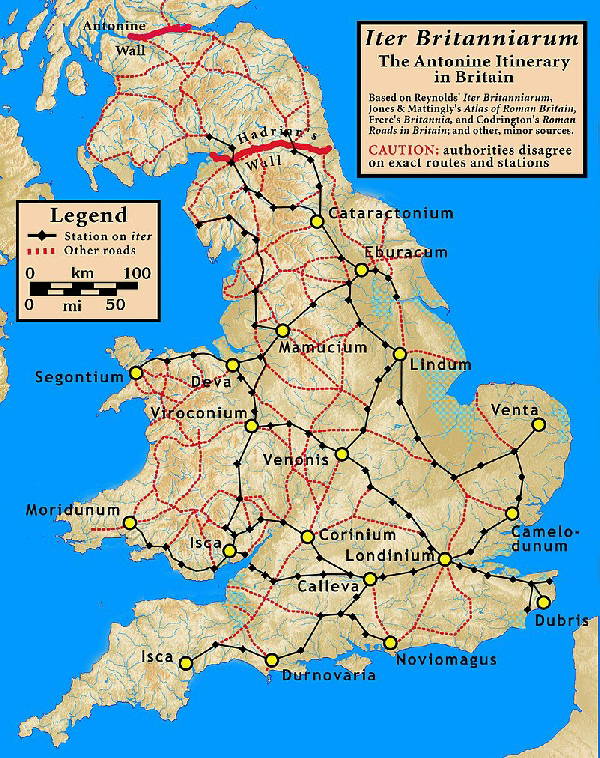
Map from Wikipedia, which, whilst far from being an accurate or definitive Roman road map of Britain, is still indicative of how in Britannia the roads probably utilised in the Itineraries (black) represent less than 25% of the whole network (other roads shown in red). Reproduced under a Creative Commons license CC BY-
References:
Arias, Gonzalo. (1987); Grammar in the Antonine itinerary. A Challenge to British archeologists, self published, Cadiz
van Berchem, D., (1937); L’Annone militaire dans l’Empire Romain au IIIe siecle.in Memoires de la Societe Nationale des Antiquaires de France, Volume xxiv, pp. 117-
Casado, C., (2013); Roman Roads: The Backbone of Empire. s.l., Fundacion Juanelo Turriano, pp. 69 –
Cuntz, Otto (1929); Itineraria Romana Vol 1; Itineraria Antonini Augusti et Burdigalense , in aedibus B. G. Teubneri, Leipzig
Edson, Charles (1951); The Location of Cellae and the Route of the via Egnatia in Western Macedonia; Classical Philology Vol 46 No. 1, pp. 1-
Fodorean, Florin-
Mann, J. C., (1987); A Note on the So-
Reed, N., (1978); Pattern and Purpose in the Antonine Itinerary. The American Journal of Philology, 99(2), pp. 228-
Rivet, A. L. F. (1970); The British Section of the Antonine Itinerary in Britannia, Volume 1, pp. 34-
Rivet, A.L.F. & Smith, Colin (1979); The Place-
Rodwell, W., (1975); Milestones, Civic Territories and the Antonine Itinerary in Britannia, Volume 6, pp. 76-
The Antonine Itinerary
From Gaul To The Britains
The British section of the Antonine Itineraries begins with the sea crossing from Boulogne to Richborough.
The stated distance of 450 stadia may at first seem high, the most direct route between Boulogne and Richborough being about 44 miles, ie 350 stadia. However, given the need to navigate hazards in the Channel, it is probably a reasonable estimate and Bede, writing in the early eighth century makes it clear that this was the accepted distance “for people crossing….(to) Ritubi Portus, ……….from Gessoriacum……is 50 miles, or as some writers have it, 450 stades” (Historia Ecclestiastica Gentis Anglorum I, I).
References:
The Antonine Itinerary – Iter I
FROM BREMENIO (HIGH ROCHESTER, NORTHUMBERLAND) TO PRAETORIO (BRIDLINGTON, EAST RIDING OF YORKSHIRE)
A limite, id est a vallo, Praetorio, m.p. CLVI (from the frontier, that is, the wall to Bridlington (?), 156 miles) –
The total distance given is the same as the sum of the stages, though there are errors, particularly the five mile under-measurement of Corbridge from High Rochester. A simple explanation is that a “v” ie five was lost at some point when the manuscript was copied.
The route follows Dere Street (RR8), running down the eastern side of the Pennines and then across the Vale of York to York. From York however, the itinerary has caused much debate over the years, arising largely from the assumption that the name Derventio must be attributed to the important fort at Malton, on the R. Derwent. The Notitia Dignitatum records a place called Derventio as being garrisoned by the Supervenientes of Petuaria (Brough on Humber) (Rivet & Smith 1979, p220 & p.155), and the proximity of Petuaria to Malton has led to the assumption the Derventio must be Malton. However the Notitia’s Derventio forms part of a list of garrisons in Cumbria, the Pennines, and County Durham, and another Derventio on a different R. Derwent at Papcastle, near Cockermouth, Cumbria is a much better fit (Wilson 2017 p.28). This obsession with Malton being Derventio has had to deal with the fact that in the itinerary the distance from York is a mere seven m.p., whereas the known route to Malton via Stamford bridge is 20.9 m.p.. This also led to the search for a direct road between York and Malton, which would be about 17.3 m.p. by the most probable route, although the archaeological evidence for such a road is limited (see RR800 in the gazetteer). Margary’s solution (Margary 1973, pp. 525-6) utilised this route, and assumed that a single “x” had been lost in copying from an original distance of “xvii”. The arguments over the locations of Derventio, Delgovicia and Praetorio have raged over centuries, and could easily fill a book. The issue was dealt with very succinctly by John Creighton (Creighton 1988, pp. 401-2) who argued that Derventio is not Malton, but the substantial Roman settlement just south west of Stamford Bridge, also on the R. Derwent and just over 7 Roman miles from York. As Creighton realised, if Derventio is Stamford Bridge, then there is a major case for Malton actually being Delgovicia, being the required 13 m.p. from the settlement at Stamford Bridge (Creighton 1988). This explanation has now been generally, but not universally, accepted.
The main issue remaining is with Praetorio. Due to the similarity of the names, writers have in the past tried to equate Praetorio with Petuaria (Brough on Humber), Civitas capital of the Parisi, although again the distances do not work, Brough being 26 Roman miles from Stamford Bridge, and 33 from Malton – not the 39 of the Itinerary. As Rivet pointed out, Petuaria would have to be corrupted in both the title and text of the manuscript and in any case, Praetorio is not actually a proper name, rather it is descriptive meaning an official residence (Rivet & Smith, 1979, p.155). A praetorium is recorded at York, but that does not preclude one elsewhere, and five other Praetoria are listed across the empire in the Itineraries. There is no need to try to force our Praetorio to be Petuaria. Looking along known roads eastwards to the coast, Creighton then argued that Praetorio might be either of the coastal sites of Scarborough or Filey, both places with known Roman occupation. The distances still are not perfect, with Scarborough being only about 20 Roman miles and Filey about 22 Roman miles, and these sites are known to have only had small military installations (watch towers). Possibly because there wasn’t a mapped Roman road heading there from Malton, Creighton didn’t consider the case for Bridlington, an omission recently corrected by Pete Wilson (Wilson 2017), although Bridlington had been long considered a candidate by many previous writers. RR812, heading east from Malton is aligned in the direction of Bridlington, and whilst a road through the Wolds is not known with certainty, it is hard to see it heading anywhere else. Along the likely route, Bridlington is almost exactly 25 Roman miles from Malton, and about 26 miles to the likely site of the Roman port, now lost to the sea (Brigham et al. 2008, p.45). This isn’t the perfect solution however, as it would leave the total mileage of the stated itinerary being clxi m.p. (161 miles), five miles more than the clvi m.p. (156 miles) in the heading, although if the “v” in the heading is a mis-reading of an “x”, the problem is solved.
Not surprisingly, the arguments will not go away, and a recent piece by Tom Ikins (Ikins 2014) tried to restate the claim for Praetorio and Petuaria being one and the same, and placed Delgovicia at a site near Wetwang, as per Rivet. The debate will probably never end!
References:
Creighton, J. (1988); The place names of East Yorkshire in the Roman period, in J. Price and P.R. Wilson (eds), Recent Research in Roman Yorkshire, BAR British Series 193, Oxford, pp. 387-406
Ikins, T. 2014: ‘The Roman name of Malton’, English Place Name List Item #4339, (Oct. 2014 16:11 www.jiscmail.ac.uk/cgi-bin/webadmin?AO-EPNL)
Margary, I. D. (1973); Roman Roads in Britain; John Baker, London
Rivet, A.L.F. & Smith, Colin (1979); The Place-names of Roman Britain; B.T. Batsford Ltd., London
Wilson, Pete (2017); Derventio,Delgovicia and Praetorio, some Roman-Period Place-Names of Eastern Yorkshire Revisited; Britannia vol. 48 2017 pp. 27-30 Cambridge University Press
The Antonine Itinerary – Iter II
FROM THE WALL – BLATOBULGO (BIRRENS, DUMFRIESSHIRE) TO THE PORT OF RUTUPIAE (RICHBOROUGH, KENT)
Item a vallo ad portum Ritupis m.p. CCCCLXXXI sic (also from the wall to the port of Richborough, 481 miles, thus)
The stated total distance is given as 481 miles, and yet the figures add up to 502, even more when adding in the missing stage before Manchester. Some of the distances for the stages, as with Iter I, are clearly wrong, although two are easy to resolve. In the Bowes to Catterick stage an “x” has been transcribed as a “v”, leaving the distance five miles short, and from Bovio to Whitchurch the reverse has happened, leaving the distance five miles too much. This does however, leave two major problems in other areas.
The first major issue is between Tadcaster and Manchester, recorded as 38 miles in the Itinerary but in reality is at least 55 Roman miles. The obvious explanation is that a stage is missing, and Richmond and Crawford proposed that this must be Camelodunum, known to be in the vicinity thanks to Ptolemy (Richmond & Crawford, 1949, p. 43). They suggested that because Cambodunum (location unknown) and the supposed following stage Camelodunum were so similar, a scribe could easily have assumed that the latter was a repetition, and leave it out. They further suggested that the distance to Manchester, xviii in the manuscript, should have read xxiii, another instance of an “x” being misread as a “v”. This placed Camelodunum firmly at Slack. Rivet & Smith took this a little further, and proposed that the distance which should have been next to Cambodunum was also omitted, so that the “m.p. xx” that should have been next to Camulodunum, became next to Cambodunum instead. In other words, rather than look for Cambodunum twenty miles from Tadcaster, we should be looking twenty miles from the fort at Slack, Huddersfield.
The main road (RR712) between York and Manchester has always been assumed to run through the centre of Leeds, and based upon a few stray finds and the supposed discovery of a Roman ford (Faull 1981 p.162), Leeds, and in particular the long destroyed earthwork at Wall Flats became the focus of attention for Cambodunum. Rivet misquoted Bede (Rivet & Smith 1979, p. 159) as placing “Cambodono in regione quae vocatur Loidis” in the region of Leeds to back up this claim, whereas Bede’s text actually reads
But in Campodonum, where there was then a royal township, he (Saint Paulinus) built a church which the pagans, by whom King Edwin was slain, afterwards burnt, together with all the place. Instead of this royal seat the later kings built themselves a township in the country called Loidis.
Bede, Historia Ecclesiastica, Book II, chapter XIV
It is therefore suggested that this section of the original itinerary read.
South east of London the route would appear to now follow RR1, as do Iters III and IV and a route shown on the Peutinger table. Because of the relationships between the three itineraries and their interpretation, the route is discussed fully on the page for Itinera III & IV. It is sufficient to say that the discrepencies in distances can all be explained by Town zones around London & Canterbury, and two copying errors. The distance from Noviomago to Vagniasis has somehow acquired an extraneous ‘x’ and ‘i’, making the original viii (eight miles) appear to be nineteen and in addition the distances next to Durolevo and Duraruerno have been transposed. The interpretation by Rivet of Noviomagus and Duralevo as Crayford and Sittingbourne respectively is confirmed as fitting the distances better than any other proposed alternatives.
The first three corrections to distances, plus the missing stage, have added five miles at Cataractonio, lost five miles at Adel (Cambodunum), added twenty miles at Cameloduno (Slack) and added five miles at Mamucio (Manchester). Ten miles were then deducted at Mediolano (Whitchurch) and eleven miles at Vagniasis (Springhead), having the net effect of adding four miles to the sum of the stages, so it now totals 506 miles. It is difficult to see how the resulting dvi could have ever been mis-copied as the cccclxxxi, although there is a logical and very simple explanation. It is highly unlikely that all the errors happened at once, and it is suggested here that the last two, at Mediolano and Vagniacis, occurred later than all the others. After the errors as far as Manchester had occurred, the sum of the stages would have been 25 miles less than the original document, which is 506-25=481, the same as the cccclxxxi that was given as the total distance on the surviving medieval copies. At some point, at least two stages of copying before that when the source manuscript of the surviving copies was created, a scribe had realised that the given total of dvi did not match the sum of the stages, and not knowing where the errors had occurred he simply altered the given total to match the sum, cccclxxxi, and it remained the same even after the errors at Whitchurch and Springhead occurred.
References:
Bede; Historia Ecclesiastica; in Sellar, A. M. (1907), Bede’s Ecclesiastical History of England; A Revised Translation With Introduction, Life, and Notes; George Bell & Sons, London. Available at https://www.gutenberg.org/files/38326/38326-h/38326-h.html#toc109 accessed 18/4/18
Faull, M (1981); Leeds and Cambodunum in Moorhouse, A. & Faull, M. (Eds), West Yorkshire and Archaeological Survey Vol. 1, West Yorkshire Metropolitan County Council, Wakefield pp. 157-162
Foreman, K (1965); in Ramm, H. G. (Ed.), Yorkshire Archaeological Register , YAJ vol 41, Leeds, p.331
Haken, M. (2012); Cambodunum – a re-appraisal, Roman Yorkshire 2, pp. 8–15
Richmond, I.A., and Crawford, O.G.S. (1949): The British section of the Ravenna Cosmography; Archaeologia 93, pp. 1–50
Rivet, A.L.F. & Smith, Colin (1979); The Place-names of Roman Britain; B.T. Batsford Ltd., London
Wilson, Pete (2016); The Roman Period Name for Adel; Britannia vol 47, pp. 280-285
The Antonine Itinerary – Iter II
FROM THE WALL – BLATOBULGO (BIRRENS, DUMFRIESSHIRE) TO THE PORT OF RUTUPIAE (RICHBOROUGH, KENT)
Item a vallo ad portum Ritupis m.p. CCCCLXXXI sic (also from the wall to the port of Richborough, 481 miles, thus)
The stated total distance is given as 481 miles, and yet the figures add up to 502, even more when adding in the missing stage before Manchester. Some of the distances for the stages, as with Iter I, are clearly wrong, although two are easy to resolve. In the Bowes to Catterick stage an “x” has been transcribed as a “v”, leaving the distance five miles short, and from Bovio to Whitchurch the reverse has happened, leaving the distance five miles too much. This does however, leave two major problems in other areas.
The first major issue is between Tadcaster and Manchester, recorded as 38 miles in the Itinerary but in reality is at least 55 Roman miles. The obvious explanation is that a stage is missing, and Richmond and Crawford proposed that this must be Camelodunum, known to be in the vicinity thanks to Ptolemy (Richmond & Crawford, 1949, p. 43). They suggested that because Cambodunum (location unknown) and the supposed following stage Camelodunum were so similar, a scribe could easily have assumed that the latter was a repetition, and leave it out. They further suggested that the distance to Manchester, xviii in the manuscript, should have read xxiii, another instance of an “x” being misread as a “v”. This placed Camelodunum firmly at Slack. Rivet & Smith took this a little further, and proposed that the distance which should have been next to Cambodunum was also omitted, so that the “m.p. xx” that should have been next to Camulodunum, became next to Cambodunum instead. In other words, rather than look for Cambodunum twenty miles from Tadcaster, we should be looking twenty miles from the fort at Slack, Huddersfield.
The main road (RR712) between York and Manchester has always been assumed to run through the centre of Leeds, and based upon a few stray finds and the supposed discovery of a Roman ford (Faull 1981 p.162), Leeds, and in particular the long destroyed earthwork at Wall Flats became the focus of attention for Cambodunum. Rivet misquoted Bede (Rivet & Smith 1979, p. 159) as placing “Cambodono in regione quae vocatur Loidis” in the region of Leeds to back up this claim, whereas Bede’s text actually reads
But in Campodonum, where there was then a royal township, he (Saint Paulinus) built a church which the pagans, by whom King Edwin was slain, afterwards burnt, together with all the place. Instead of this royal seat the later kings built themselves a township in the country called Loidis.
Bede, Historia Ecclesiastica, Book II, chapter XIV
It is therefore suggested that this section of the original itinerary read.
South east of London the route would appear to now follow RR1, as do Iters III and IV and a route shown on the Peutinger table. Because of the relationships between the three itineraries and their interpretation, the route is discussed fully on the page for Itinera III & IV. It is sufficient to say that the discrepencies in distances can all be explained by Town zones around London & Canterbury, and two copying errors. The distance from Noviomago to Vagniasis has somehow acquired an extraneous ‘x’ and ‘i’, making the original viii (eight miles) appear to be nineteen and in addition the distances next to Durolevo and Duraruerno have been transposed. The interpretation by Rivet of Noviomagus and Duralevo as Crayford and Sittingbourne respectively is confirmed as fitting the distances better than any other proposed alternatives.
The first three corrections to distances, plus the missing stage, have added five miles at Cataractonio, lost five miles at Adel (Cambodunum), added twenty miles at Cameloduno (Slack) and added five miles at Mamucio (Manchester). Ten miles were then deducted at Mediolano (Whitchurch) and eleven miles at Vagniasis (Springhead), having the net effect of adding four miles to the sum of the stages, so it now totals 506 miles. It is difficult to see how the resulting dvi could have ever been mis-copied as the cccclxxxi, although there is a logical and very simple explanation. It is highly unlikely that all the errors happened at once, and it is suggested here that the last two, at Mediolano and Vagniacis, occurred later than all the others. After the errors as far as Manchester had occurred, the sum of the stages would have been 25 miles less than the original document, which is 506-25=481, the same as the cccclxxxi that was given as the total distance on the surviving medieval copies. At some point, at least two stages of copying before that when the source manuscript of the surviving copies was created, a scribe had realised that the given total of dvi did not match the sum of the stages, and not knowing where the errors had occurred he simply altered the given total to match the sum, cccclxxxi, and it remained the same even after the errors at Whitchurch and Springhead occurred.
References:
Bede; Historia Ecclesiastica; in Sellar, A. M. (1907), Bede’s Ecclesiastical History of England; A Revised Translation With Introduction, Life, and Notes; George Bell & Sons, London. Available at https://www.gutenberg.org/files/38326/38326-h/38326-h.html#toc109 accessed 18/4/18
Faull, M (1981); Leeds and Cambodunum in Moorhouse, A. & Faull, M. (Eds), West Yorkshire and Archaeological Survey Vol. 1, West Yorkshire Metropolitan County Council, Wakefield pp. 157-162
Foreman, K (1965); in Ramm, H. G. (Ed.), Yorkshire Archaeological Register , YAJ vol 41, Leeds, p.331
Haken, M. (2012); Cambodunum – a re-appraisal, Roman Yorkshire 2, pp. 8–15
Richmond, I.A., and Crawford, O.G.S. (1949): The British section of the Ravenna Cosmography; Archaeologia 93, pp. 1–50
Rivet, A.L.F. & Smith, Colin (1979); The Place-names of Roman Britain; B.T. Batsford Ltd., London
Wilson, Pete (2016); The Roman Period Name for Adel; Britannia vol 47, pp. 280-285
The Antonine Itinerary – Iter III & IV
FROM LONDINIO (LONDON) TO Dubris (DoveR)
FROM LONDINIO (LONDON) TO LEMANIS (LYMPNE)
ITER II – LONDON TO RICHBOROUGH SECTION
ITER III
ITER IV
The site of Noviomagus (meaning New Market) has never been found but Iter II gives the location of Noviomagus as ten miles from London, so with the proposed Town Zone we need to look in an area on Watling Street 13 miles from London Bridge which leads to an area on or near the modern A207, about half a mile west of the R. Cray, near Crayford. Slightly raised ground, not too far from the river, makes perfect sense for a settlement and especially a market, although locating the site is now extremely difficult since most of the area is covered by modern development. Rivet was not so specific, but did conclude that Noviomagus must be near Crayford. Unfortunately, Pastscape (monument no. 410937) still bears an entry for Noviomagus at a Roman period settlement site a couple of miles south west of Dartford which used to be accepted as Noviomagus in the mid 20th century but it is simply too far from the road (2.5 miles) and the distances do not work. It should be discounted.
The next stage on Iter II is Vagniacis which is not known from any other document. If the distance of 19 miles were correct, then the only possibility would be that the itinerary made a detour to a site somewhere near Maidstone along a road that is not known, then from Maidstone to Rochester along RR13. This may be possible, but seems unlikely as the straight line distance to Maidstone would be about 22 Roman miles, three miles too far. Rivet and Smith assumed that the xviiii measurement is a copying error (Rivet & Smith 1979, p.161), and should be simply viiii, and place Vagniacis at the known Roman period settlement at Springhead (TQ6177 7247). It is now marked as such on Ordnance Survey maps. This is still very slightly problematic, as the true distance from the most likely site of Noviomagus is about 8 Roman miles, not nine, and it is probable that a further error in copying crept in which added an extra “i” (see final paragraph of account of Iter II), possibly an accidental transfer of the distance for the next stage. The distance from Springhead to Rochester is 8.7 Roman miles, very close to the stated nine miles, so locating Vagniacis at Springhead is fairly safe.
The Roman town of Durobrivae stood on the east bank of the R. Medway in what is now Rochester, with the main Roman road (Watling Street RR1) running through its heart, and is included in Itinera II, III, IV and the Peutinger table. Iter II gives Durolevo as the next stage some 13 miles further on. Durolevo is omitted from Iters III & IV although in the Peutinger table the distances are clearly corrupted being only “vii” with another “vii” to Canterbury, totalling 14 miles, whereas the actual distance is 28.3 miles, measured from the town walls (not the 27 miles quoted in Rivet & Smith). Durolevo should therefore be about 13 miles from Rochester, placing it on or just beyond the eastern edge of modern Sittingbourne. Whilst there is no known settlement in this general area, the numerous Roman finds from the town, including several cemeteries, are suggestive of a substantial settlement, although the focus of known Roman occupation is slightly to the north west, which would make the distance closer to 12 miles from Rochester, rather than 13. From there, the distance to the putative town zone of Canterbury would be about 13.3 miles, so the distances in the itinerary are slightly out. A simple explanation would be that a copyist transposed the distances for the two entries. Sittingbourne, therefore, is a much better fit than the other frequently quoted contender for Durolevo, at Ospringe, SW of Faversham. The confirmed evidence for occupation at Ospringe is not really suggestive of a large settlement, unlike that at Sittingbourne, and the probable site (Pastscape, Mon. 419935) is 18 miles from Rochester which cannot be explained by any straightforward error of transmission. On balance, identification of Durolevo as a settlement now beneath northern Sittingbourne seems most likely.
All four documents move on to Canterbury (Durovernum Cantiacorum), after which Iter II goes on to Richborough, Iter III to Dover, and Iter IV to Lympne. The distance for Iter II to Richborough is given as twelve miles, one mile short of the true distance of thirteen miles, with the distance on Iter III to Dover given as 14 miles, which is two short. Lympne, on the other hand, is correct at 16 miles. These variations in accuracy of distance are impossible to explain by a town zone around Canterbury which was of a regular radius. If a town zone is actually the reason for the shortfalls in distance, then we must conclude that it was irregular, extending as much as two miles out to the north west and south east, but only a mile eastwards toward Richborough and hardly at all to the south toward Lympne.
References:
Pastscape Mon. No. 410937 (2017) Noviomagus http://www.pastscape.org.uk/hob.aspx?hob_id=410937 [accessed 17/9/17]
Pastscape Mon. No. 419935 (2017) Durolevumhttp://www.pastscape.org.uk/hob.aspx?hob_id=419935 [accessed 17/9/17]
Rivet, A.L.F. & Smith, Colin (1979); The Place-names of Roman Britain; B.T. Batsford Ltd., London
Rodwell, W., (1975); Milestones, Civic Territories and the Antonine Itinerary; Britannia, Volume 6, pp. 76-101.
Talbert, Richard J. A. (2010); Rome’s World: The Peutinger Map Reconsidered, Cambridge University Press, Cambridge
Talbert, Richard J. A. (2010); Peutinger Map: seamless whole, in color, with overlaid layers available online at http://peutinger.atlantides.org/map-a/; [accessed 11/9/17]
The Antonine Itinerary – Iter V
FROM LONDINIUM (LONDON)
TO LUGUVALIUM (CARLISLE, CUMBRIA)
Item a Londinio Luguvalio ad vallum m.p. ccccxliii sic (also from London to Carlisle on the wall 443 miles thus)
The distance from London to Chelmsford however is given here as 28 miles, whereas in Iter IX it is recorded as 31 miles, probably accounted for by Iter IX taking a non-direct route via Chigwell. The two itineraries are not quite in agreement for the next stage to Colchester either, although Iter IX is only a mile less. From Colchester to Caistor, as Rivet and Smith point out, the stated mileage of 53 miles is inadequate, the actual distance being 59 miles. This inaccuracy doesn’t help when trying to locate the intermediate stage, Villa Faustini, which could be either the known Roman settlement at Scole, or the one at Stoke Ash. Both alternatives would cause a discrepancy of five miles, although on different lines, and both can be explained away by the accidental substitution of a “v” for an “x”, a very common error in the itineraries. The appearance of a villa name is unique for the Itineraries in Britain, but there are no less than seven listed in Africa (Rivet & Smith 1979, p.163).
The next issue lies with Camboricum or as Rivet & Smith suggest, Camboritum. Lackford, where there is some evidence of Roman occupation, is usually given as the probable location although there is no known settlement as such. It is, however, on the Icknield way, usually regarded as a Romanised prehistoric trackway. The possible alternative site, Hockwold-cum-Wilton, on the R. Little Ouse, is a sizeable linear settlement along a known Roman road (RR332) but it’s course further west is not known and there is no known link road to get to Cambridge although it seems likely that 332 continues to meet RR23b. A one and a half mile long settlement doesn’t develop on a road that goes nowhere. Hockwold as a large settlement seems more suitable but the recorded distances are a very poor fit being 5 miles too short from Caistor and four miles too short from Cambridge, so on balance Lackford is more likely.
From Cambridge, the next stage to the settlement at Water Newton is without major issue. From there, however, there are three possible routes to Lincoln. The first is by King Street (RR26) to Bourne, and then by Mareham Lane (RR260) to Lincoln, although there is no evidence for a Roman settlement in roughly the right place for Causennis on this route, so it can probably be disregarded. The second and third routes are along Ermine Street (RR2c) via Ancaster, or along King Street (RR26) as far as Bourne, then keeping to King Street as far as Ancaster, and then Ermine Street to Lincoln. Ancaster is the traditional identification of Causennis but it is seven miles further on than the 30 miles of the itinerary, on either of these two routes. However, there is a known settlement near Sapperton, on the third route, King Street (RR26), 30 miles from Water Newton. As this is the only known site that fits with the given distances, it seems most likely that this is Causennis, and this identification is now fairly well accepted. A known settlement at Saltersford has also been suggested (Rivet & Smith 1979, p.164) but that lies a mile and a half west of Ermine Street and seems highly unlikely.
From Lincoln onwards, all the place names are all known, so the only remaining issue is the total mileage. The stated distance is 443 miles, which is in agreement with the sum of the stated distances, however we have had to add five miles to a stage at the Villa Faustini, whether it is Stoke Ash or Scoles, taking the total of the stages to 448 miles. Whilst it is possible that a “v” was accidentally omitted from the stated total on the first line of the iter, it seems more likely it was deliberately omitted at some point when the manuscript was copied, as the easiest way of making the totals match. However, it is also difficult to reconcile the stated 18 miles from Catterick to Bowes, in reality 21, a stage that in Iter II was recorded as just 16 miles, which we had to adjust to 21 by adding a “v”. Rivet & Smith suggest that the Bowes issue could be caused by missing milestones, which can’t be ruled out (ibid.), especially as the use of the tribal name “Icinos” for Caistor may indicate quite a late date for Iter V. There is one other possibility in that a direct route from Catterick to Bowes avoiding Scotch Corner would be only 19 miles, just one mile too many, which is very common in the Itinerary probably due to measurement form the edge of a “town zone”. A road heading SSE from Bowes is known, and has been assumed to be heading to the shrines on Scargill Moor and on to Bainbridge, but it is just conceivable that it was also part of an alternative direct route to Catterick, although currently there is no evidence whatsoever to support this hypothesis.
As a footnote, it is worth mentioning briefly that the distance from Littleborough to Lincoln, given both here and in Iter VIII as 14 miles. During the research for this website a previously unknown road was discovered, from Lincoln to a point along RR28a near Scampston, to which we have given the number RR28aa. This road shortens the distance from Lincoln to Littleborough by 0.75 Roman miles, there are therefore two potential distances, 13.6 miles and 14.35 miles between the two sites, which unfortunately both round off to 14. Whilst we cannot be certain, it might be safe to conclude that the “new” RR28aa was built some time after both itineraries were written. Therefore, the route for the itineraries could have gone either way, so we are unable to determine whether or not the “new” road was constructed before the Itineraries were compiled.
References:
The Antonine Itinerary – Iter VI
FROM LONDINIUM (LONDON)
To Lindum (LINCOLN)
References:
The Antonine Itinerary – Iter VII
FROM [NOVIOMAGUS] REGNORUM (CHICHESTER)
To LONDINIO (LONDON)
Item a Regno Lundinio, m.p. xcvi sic. (also, from Chichester to London, 96 miles, thus)
The sum of the mileages does match the total given in the heading, however there are obvious errors. The association of Clausentum with the known Roman site at Bitterne, Hampshire, has been made since the eighteenth century but there is is no other corroboration for this. The distance from Bitterne to Winchester is ten miles too far but an omission by a copyist of a single “x” is a potentially simple explanation.
Another possibility worth consideration is that Clausentum may have been the Roman site of uncertain nature at Wickham, Hampshire (Pastscape mon. 234684), which is about 20 Roman miles from Chichester. Unfortunately, it is 14.5 Roman miles from Winchester and a Town zone of 4.5 miles would be unprecedented and excessive. On balance, Bitterne remains the favourite contender.
The other errors in mileage are almost impossible to explain whilst keeping the given total mileage the same. It must have been altered in some way, either erroneously or deliberately. Given that the place-names are known with certainty, it is perhaps best to simply use this section as a prime example of how multiple errors have crept in over two millenia. Iter VII serves as a warning for anyone trying to use the figures to find a missing or un-attributed name, to proceed with extreme caution.
References:
Rivet, A.L.F. & Smith, Colin (1979); The Place-
The Antonine Itinerary – Iter VIII
FROM EBURACO (YORK)
To LONDINIO (LONDON)
It is worth mentioning briefly the distance from Littleborough to Lincoln, given both here and in Iter VIII as 14 miles. During the research for this website a previously unknown road was discovered, from Lincoln to a point along RR28a near Scampston, to which we have given the number RR28aa. This road shortens the distance from Lincoln to Littleborough by 0.75 Roman miles, there are therefore two potential distances, 13.6 miles and 14.35 miles between the two sites, which unfortunately both round off to 14. Therefore, the route could have gone either way, so we are unable to determine whether or not the “new” road was constructed before the Itinerary was compiled.
References:
The Antonine Itinerary – Iter IX
FROM VENTA ICENORUM (CAISTOR ST. EDMUND, NORFOLK)
To LONDINIO (LONDON)
Item a Venta Icinorum Lundinio, m.p. cxxviii sic. (also, from Caistor to London, 128 miles, thus)
The total distance given in Rivet & Smith for this itinerary of cxxvii (Rivet & Smith 1969 p.168) is a misprint which omits an “i”, an ample demonstration, if one were needed, of how easy it is for errors to creep in. The stated total distance of 128 miles is one more than the sum of the stages, which is 127 miles, so it seems unlikely that there are any major errors of distance.
Some of the route (the Ad Ansam to Colchester then Chelmsford section), is included in Iter V. The most fascinating differences between the two are the differences in nomenclature. In this itinerary Colchester is Camulodunum, probably derived from the town’s pre-Roman roots and yet in Iter V it is Colonia, an abbreviation of Colonia Claudia Victricensis, celebrating the successful Claudian invasion of AD 43. Similarly, yet curiously reversed, in Iter IX the Civitas capital of the Iceni at Caistor st. Edmund is Venta Icenorum, and yet in Iter V it is Icinos, substituting the tribal name for the city, a practice common in Gaul but not here in Britain (Rivet & Smith 1979, p.162). The distances between Caistor and Colchester in the two itineraries are also quite different, 54 miles in Iter V, and 75 miles in Iter IX. Iter IX also includes many more stages, and omits the Villa Faustini of Iter V. The Peutinger table lists the same places as Iter IX and allowing for probable copying errors, gives the same distances totalling 75 miles. The probable conclusion is that Iter V followed the direct route between Caistor and Colchester along RR3 whereas Iter IX followed a more circuitous route.
Identifying the places between Caistor and Colchester in Iter IX, which also appear in the Peutinger table but not in Iter V, is problematic. It is easiest to consider them from south to north. Rivet and Smith conclude that Ad Ansam must refer to a site near a bend in the R. Stour (ibid. p.169) however there are two Roman roads from Colchester that cross the river, one at Nayland (RR322) and the other near Stratford St. Mary, Suffolk (RR3c), and both could form part of a route to Caistor. The Nayland crossing seems unlikely, partly because there are no probable identifications with known Roman sites either at Nayland, or at stages further on, and partly because the distance by the this route is about six miles further. Bearing this in mind, RR3c seems a better bet, although the exact course of a crossing of the river Stour near Stratford St. Mary is not known. There is a probable Roman settlement near Higham, about ¾ mile upstream (Pastscape mon. 386555) which seems a likely candidate.
The next stage, Conbretovium, some 22 miles further on along RR3c, is usually identified as the large Roman settlement at Baylham House, near Coddenham (Pastscape Mon. 388704), where no less than five roads meet. The settlement must also have been on the route of Iter V but is not listed. The name may well also have applied to the two known Roman forts nearby.
From here, however, things are far less certain as it seems that the route diverted to a site known as Sitomagus (location uncertain) which must be on a different road. The course advocated by Rivet and Smith is along RR34 to Peasenhall, then along RR35 until it rejoins RR3d, then on to Caistor. The distances aren’t quite enough. For this to work, the site of Sitomagus would have to be another three miles east from the junction of the two roads, on a currently unknown road, placing it near Yoxford where the itinerary would actually double back on itself along the same road to get to Caistor. It isn’t a perfect solution by any means, however there is an alternative which fits much better. By turning WSW from Conbretovium along RR34a and then heading north along RR330 would bring the traveller to the fort and later settlement at Ixford, Suffolk (Pastscape Mon. No 385185 ) a distance of about 23 Roman miles. Whilst there is some uncertainty about the course of both roads, the probable distance agrees extremely well with the 22 miles of the Itinerary.
From there, by means of RR33a, RR331, RR37 and RR3d to Caistor, it is a further 33.6 miles, 1.6 miles more than the stated distance. This could feasibly be the source of missing mile from the stated total of the itinerary. Given the uncertainty about the route of RR37, the distances are acceptable and Ixworth seems a much better contender for Sitomagus than a so far undiscovered site near Yoxford. However, two other contenders have emerged in east Suffolk, namely the possible settlement at Knodishall (31 miles from Caistor, 20.5 miles from Coddenham) and a nearby possible settlement at East Green, a mile north of Knodishall (30 miles from Caistor and 20 miles from Coddisham) (Steerwood 2003). Unfortunately, the roads proposed to make these suggestions work are only partially known so there has to be a large element of doubt (N.B. Steerwood also proposes the major settlement at Wenhaston, but the distances are impossible to explain).
Considering the route of Iter IX south of Colchester, the only place not known is Durolitum. Sixteen miles from Chelmsford along the road to London (RR 3a) takes us to Gidea Park in the outskirts of Romford, which is also 15 Roman miles from London. There is, unfortunately, no real evidence for a settlement site at or near this location, although there have been Roman finds in the vicinity. Another possibility, which is accepted by many, is that Durolitum is the known settlement at Little London, Chigwell (Pastscape Mon. No. 408199). Gravel workings have removed most of the evidence of occupation but evidence discovered prior to that leaves no doubt that this was a settlement site. The site is on RR30 to London, however there is no known road linking it to Chelmsford, which is problematic, and it would be 18.5 miles from Chelmsford along an almost straight route (which isn’t really possible), not the 16 of the itinerary or the distance stated in Rivet and Smith (Rivet and Smith, 1979, p.170), although a town zone may account for this. From Chigwell, it is 13.5 miles from London rather than the 15 of the itinerary, too short. Chigwell has been left as the possible site of Durolitum in this Itinerary, albeit reluctantly, because there is currently no other alternative site.
References:
Steerwood, Robert (2003) A context for Sitomagus: Romano-British Settlement in the Suffolk Mid-Coastal area; Proceedings of the Suffolk Institute of Archaeology and History, volXL Part 3 pp. 253-261
Talbert, Richard J. A. (2010); Rome’s World: The Peutinger Map Reconsidered, Cambridge University Press, Cambridge
Talbert, Richard J. A. (2010); Peutinger Map: seamless whole, in color, with overlaid layers available online at http://peutinger.atlantides.org/map-a/; accessed 11/9/17
The Antonine Itinerary – Iter X
FROM GLANNOVENTA (?RAVENGLASS, CUMBRIA) TO MEDIOLANUM (WHITCHURCH, SHROPSHIRE)
Item a Clanoventa Mediolano, m.p. cl sic. (also, from Ambleside to Whitchurch, 150 miles, thus)
In 1921, Taylor & Collingwood wrote “The Tenth Iter in the British section of the Antonine road-
The identification of the four forts at the northern end of the itinerary, however, have been subject to much debate over recent decades. After Haverfield identified Clanoventa at the start of the Itinerary with Ravenglass (Haverfield, 1915), the association quickly became accepted, as did his other interpretations of Ambleside as Galava, Watercrook as Alone, and Galacum as Overburrow. that necessarily followed (fig. 2). There is, however, a major problem with this. A lead sealing of the cohors I Aelia Classica in garrison at Tunnecelum was found at Ravenglass during excavations (Potter, 1979, pp. 73-
If Haverfield’s interpretation was incorrect, what is the correct one? Attempting to solve this question is not made easier by our very poor knowledge of the road network in the southern Lake District, although the route of the road from Ambleside to Watercrook has finally been identified (Ratledge, 2017). There have been several attempts to resolve the issue, and they are set out in the table below (fig. 2). Rivet’s route can be rejected because it starts at Ravenglass, and to get from Ambleside to Low Borrow Bridge utilises a very un-
In an attempt to resolve these first few stages, the author has taken a fresh look at the distances, working backwards from the first certain identification, Bremetonnacum (Ribchester), and another possible solution has emerged which fits the Itinerary extremely well.
References:
Durham, A. (2017) Pers. Comms.
Hassall, M.W.C. & Tomlin, R.S.O (1995) Roman Britain in 1994; II, Inscriptions; Brittania Vol 26 Society for the Promotion of Roman Studies, London pp. 371 –
Haverfield, F.(1915); The Romano-
Holder, P.A. (1997) A Roman Military Diploma from Ravenglass, Cumbria Bulletin of the John Rylands Library Vol 79 (1) University of Manchester; pp. 3-
Holder, P. (2004); Roman place-
Miller, Ian & Aldridge, Bill (2011) Discovering Coccium: The Archaeology of Roman Wigan; Oxford Archaeology North
Potter, T. W. (1979); The Roman Fort at Ravenglass in Romans in North-
Ratledge, D. (2016) Pers. Comms.
Ratledge, D. (2017); The Roman Road from Watercrook to Ambleside, Margary 70f; RRRA website http://www.romanroads.org/gazetteer/cumbria/M70f.htm accessed 13/2/18
Rivet, A.L.F. & Smith, Colin (1979); The Place-
Rodwell, W., (1975); Milestones, Civic Territories and the Antonine Itinerary in Britannia, Volume 6, pp. 76-
Shotter, David (1998); Roman Names for Roman Sites in North West England; Contrebis, Vol 23, Lancaster. pp. 9-
Smith, I.G. (1997); Some Roman Place-
Taylor M. V. & Collingwood, R.G. (1921) Roman Britain in 1921 and 1922 in The Journal of Roman Studies Vol 11; Society for the Promotion of Roman Studies, London. pp. 200 –
Wilson, T. (1884); The Roman Road over Whinfell; Trans. Cumberland & Westmorland Antiquarian & Archaeiological Society Vol. 7, pp. 90-
The Antonine Itinerary – Iter XI
FROM SEGONTIUM (CAERNARVON)
To DEVA (CHESTER)
The next stage, to Varis, is more problematic. The route of RR67b is not so well established with Margary describing a rather indirect and unlikely route (Margary, 1973, pp 349-50). Waddelove’s proposed route makes more sense (Waddelove, 1983), and his identification of the course of the road in St. Asaph approximately 400m south of the cathedral seems sound (Waddelove, 2004), supporting the long held assumption of St. Asaph being the location of Varis. Whilst a definite Roman settlement or fort has never been conclusively established, the town’s distance from Conovium (18 Roman miles) certainly fits and the scattered finds of coins, pottery and tile are certainly suggestive of Roman settlement. The discovery of ditches and road surfaces in the town have led to an interpretation of a probable fort (Waddelove 2004).
Assuming that Varis is St. Asaph, the route will have followed RR76a east and then along the coast. Rather than approach Chester along RR66a, the northern part of of which through Lache is far from certain, it is more likely that the Iter followed an extension of RR76a continuing further east to skirt around the south of the wetlands of the Dee estuary meeting RR6 near Eaton Hall. If so, the distance would be almost 33 Roman miles, agreeing well with the 32 miles of the Iter. Incidentally, the distance from St. Asaph to Chester is another example of inaccuracy in the measurements of true distances given in Rivet and Smith (Rivet & Smith 1979, p.172), as they state the true distance to Chester as being 34 miles.
References:
Margary, I.D. (1973); Roman Roads in Britain (3rd Edition); Baker, London
Rivet, A.L.F. & Smith, Colin (1979); The Place-names of Roman Britain; B.T. Batsford Ltd., London
Rodwell, W., (1975); Milestones, Civic Territories and the Antonine Itinerary in Britannia, Volume 6, pp. 76-101
Waddelove, A.C. (1986); The Development of a Roman Road Network in the Lower Dee Valley Region before AD 117, unpub M. Phil, thesis University of Manchester
Waddelove, E. (1983); The Roman road between Varis and Canovium, Archaeologia Cambrensis vol. 132, pp.95-106
Waddelove, E. (2004); A Roman Fort at St. Asaph and the Location of Varis in Britannia, Volume 35, pp. 248-252
The Antonine Itinerary – Iter XII
FROM MORIDUNUM (CARMaRThEN)
TO VIROCONIUM CORNOVIORUM (WROXETER, SHROPSHIRE)
Item a Muridono Viroconiorum, m.p. clxxxvi (also, from Carmarthen to Wroxeter, 186 miles
Despite its appearance in every manuscript, the first section of this iter is clearly intrusive, being just a repetition of Iter XV. It must have happened when a manuscript was being copied, the new copy later becoming a common root for all the surviving copies, possibly because of two different places called Muridunum. Whether leaving it in or taking it out, the total mileage of 186 miles is wrong since the stages add up to either 292 or 166 miles (not the 146 miles stated in Rivet & Smith 1979 p.174).
That Muridunum is the fort and walled town at Carmarthen is beyond doubt, and Leucarum really ought to be the Roman fort at Loughor. The problem lies in there being no confirmed road between the two. Margary speculated that there was a Roman road, RR60d, leaving Carmarthen through Cwmffrwd, represented by a very straight length of part of the A484 and then the B4309 and then roughly represented by the B4306, which follows a sinuous line along a generally straight course, through the hills and valleys to Llannon, and Pontyberem, crossing the river Loughor near Hendy (Margary, 1973, pp. 326-
There is, however, a certain road, identified from aerial photographs, which branches from Margary’s line at Cwmffrwd, and then heads south along the very straight Gheol-
From Loughor, a road must head to the fort at Neath (Nido), although its route is not known as Margary acknowledged (Margary, 1973, p.326). The most likely route would be represented by the B4620, past several Roman practice works, then into what is now Swansea. A supposed Roman ford was found crossing the Tawe near Hafod in Swansea (GGAT HER 01016.18w), although given the width of the R. Tawe, and that the river is tidal, a bridge seems almost certain. The route is likely to be close to that of the A4217 and A 4230 to Neath, which would give a distance of almost 14 Roman miles, so it is possible that the ‘xv’ as written was the intended figure, even though it is a mile too many.
From Neath, Rivet and Smith followed Margary’s route for RR60c along the coast, the route of which still has a few question marks over it but in general terms seems fairly safe. They concluded that Bomium was the small town and possible fort at Cowbridge (GGAT HER no. 00272s), which remains the most likely interpretation. Unfortunately, the distance from Neath to Cowbridge doesn’t work, as it is about 27 Roman miles, not the 15 of the Iter, whereas in the other direction the distance to the fortress at Caerleon is almost 28 miles and agrees well with the 27 miles of the Itinerary. Attempts have been made to try to solve the mileage problem by assuming a missing stage and then placing Bomium at a site on or close to the R. Ewenny, south of Bridgend (Sherman, 2009 p.89), although such a site has not yet been found. Until one is, Bomium is most safely identified with Cowbridge, the mileage issue being explained by a simple accidental repetition of the previous xv, very easily done given that the distance should have read xxvii, the same as the next entry. This must have happened at a later stage than the other two previous errors. With so many successive errors in this Iter, the answer may never be known for sure.
From Caerleon the distances agree fairly well, and the route of RR630 north of Abergavenny is now known, showing clearly on lidar. If this re-
References:
Archaeoleg.org.uk (2008); A Research Framework for the Archaeology of Wales: Key Sites Southeast Wales IFA Wales/Cymru
Available at http://www.archaeoleg.org.uk/pdf/roman/KEY%20SITES%20SE%20WALES%20ROMAN.pdf
Evans, E. (2001); Romano-
Available at http://www.walesher1974.org/herumd.php?group=GGAT&level=3&docid=301360168 accessed 3/11/2017
Margary, I. D. (1973); Roman Roads in Britain; John Baker, London
Rivet, A.L.F. & Smith, Colin (1979); The Place-
Sherman, A. (2009); Island Farm, Bridgend, Archaeological desk-
Available at http://www.walesher1974.org/herumd.php?group=GGAT&level=3&docid=301360458 accessed 03/11/2017
The Antonine Itinerary – Iter XIII
FROM ISCA SILURUM (CAERLEON, GWENT)
TO CALLEVA ATREBATUM (SILCHESTER, HAMPSHIRE)
Item ab Isca Calleva, m.p. cviiii (also, from Caerleon to Silchester, 109 miles, thus)
Iters XIII and XIV are alternative routes between Caerleon and Silchester, both previously regarded as having issues, although as will be shown, it is only Iter XIII that is problematic.
In Iter XIII, the mileages adds up to 90 instead of the stated total of 109, and given that only 44 miles are allowed between Gloucester and Silchester, which are 67 Roman miles apart in a straight line, a stage has clearly been omitted. As Rivet rightly observed, this can only be Corinium (Cirencester), which is just over eighteen Roman miles from Calleva (Clevo, ie Gloucester), which allowing for two town zones of two miles each could just conceivably have been recorded as fourteen miles (Rivet & Smith 1979, p.175). It seems possible that the omission occurred because of the similarity between Corinium and Durocornovium, the next stage (Rodwell, 1975, p.89).
This leaves a mileage shortfall of just five miles. The next stage, Durocornovium, is recorded as fourteen miles from Corinium along Ermin Street, however allowing for the two mile town zone, the real distance should be sixteen miles, which takes us to the Roman settlement at Wanborough (Pastscape Mon No. 221858), at the junction of RR41b and RR43. Iter XIIII gives the same mileage for the final stage between Spinis and Calleva (m.p.xv); therefore the mileage error must be with the penultimate stage, from Durocorniovum to Spinis. It would be a fair assumption that the distance should have read ‘xx’, the last ‘x’ being misread for a ‘v’, a very common error in the Itinerary.
The location of Spinis is problematic. There is no known site at the stated distance of fifteen miles, nor would we expect there to be as the distance should probably have read ‘m.p. xx’, ie twenty miles.The only site that fits is at Speen, just west of Newbury, for which the confirmed evidence is extremely slight (two coins) although there are 19th century claims for much Samian pottery and tiles during the construction of Speen House, but they remain only claims since a Roman site has not been found. The similarity of placenames would seem to fit. Speen was recorded as Spenes (1167) and Spenis (1224) (West Berks. HER MWB4831, 2017), although Gelling claimed that the Anglo-
References:
Gelling, M. (1973); The Place Names of Berkshire – Part One. English Place-Name Society Vol XLIX. .
Margary, I. D. (1973); Roman Roads in Britain; John Baker, London
Rivet, A.L.F. & Smith, Colin (1979); The Place-names of Roman Britain; B.T. Batsford Ltd., London
Rodwell, W., (1975); Milestones, Civic Territories and the Antonine Itinerary in Britannia, Volume 6, pp. 76-101
West Berkshire HER MWB4831 (2017); Speen Village; http://www.heritagegateway.org.uk/Gateway/Results_Single.aspx?uid=MWB4831&resourceID=1030 [Accessed 28 September 2017]
The Antonine Itinerary – Iter XIV
FROM ISCA SILURUM (CAERLEON, GWENT)
TO CALLEVA ATREBATUM (SILCHESTER, HAMPSHIRE)
Item alio itinere ab Isca Calleva, m.p. ciii (also, an alternative route from Caerleon to Silchester, 103 miles)
Iters XIII and XIV are two alternative routes between Caerleon and Silchester, both previously regarded as having issues.
In Iter XIV, the mileages add up correctly to the stated 103 miles and all the place-names are generally accepted, although doubt has recently been expressed about Abone and Traiectus (Durham 2018 a & b). The first stage to Caerwent along RR60a is without issues, and from there the route continues east as far as Crick, where a side road branches off (RR60aa) to head down to Sudbrook, where there was a ferry terminal to cross the Severn estuary. The port of Abone (or Abona), on the other side of the Severn, is almost certainly Sea Mills, on the edge of modern Bristol, about four miles up the R. Avon from its confluence with the Severn estuary. Its name is borrowed, like so many Roman names, from the adjacent river, in this case the R. Avon. The journey may have been entirely by ferry to Abone (Sea Mills), or as Rivet & Smith assume, part ferry and part road (Rivet and Smith, 1979, p.177). Either way, the journey from Venta to Abone is just over 14 miles, possibly a little further to navigate around possible obstructions in the estuary, so this fits the distance given perfectly.
There is, however, a problem: Traiectus (referring to a water crossing) appears after Abone, not before it. In the itineraries, the word traiectus has three subtly different uses;
In a maritime itinerary for a long sea crossing, measured in stades,
In a land itinerary for a short sea crossing as part of a long route, and is measured in miles, or as a link between two different routes, when it is measured in stades.
In a land itinerary as the name of a place at a river crossing (Rivet & Smith 1979, p.177)
Haverfield summed up the issue, and dismissed the obvious solution (Haverfield, 1906, pp. 347-8)
“It would at first sight seem natural to identify Traiectus with Bitton and Abone with Seamills. This solution, however, raises serious difficulties. Seamills is indeed not much more than nine miles from Bitton. But Bitton is ten or eleven, not six, Roman miles west of Bath, and no ‘station’ except Bitton exists on this part of the route. Again, no ‘traiectus’ worth the name occurs near Bitton nor indeed anywhere on the route except at the crossing of the Severn.”
Unfortunately, he was wrong on two counts. Firstly, there is a probable traiectus across the R. Avon just to the south of Bitton, on RR546, a road which was confirmed in March 2017 as part of the Stanton Drew Environs Aerial Mapping Project (Pastscape, Mon. 1325732 2017). Secondly, Bitton is just over six Roman miles from Bath so where Haverfield got “ten or eleven miles” from is anyone’s guess! Rivet postulated that a settlement at Bitton could have borrowed the name Traiectus from a short ferry or ford across the Avon, which we now know must have existed, so he may have been right. The settlement is poorly understood, but is apparent from the plethora of finds in the area of ST 6820 6940 (Pastscape Mon. 200844, 2017). Partly in an attempt to explain why there is no mention of a traiectus across the Severn, and to make up the five miles that he reasoned needs to be deducted from a stage later on, Rivet also suggested (Rivet & Smith 1979, p.178) that there must be a missing stage of Sabrinae Traiectus (ie Severn Crossing) with a distance of m.p. v, between Venta and Abone. This is hard to comprehend, as there is no space for it in the Iter, Abone being between 14 & 15 Roman miles from Venta, depending on the route across the Severn.
Another possible explanation has been proposed by Anthony Durham (Durham 2018, a&b), who suggests that the second and third lines, the entries for Abone and Traiectus, have been transposed, so that Traiectus is a ferry terminal on the Severn estuary somewhere north east of Avonmouth, and Abone is Bitton, which is on the R.Avon and would therefore fit the name. In theory, this explanation works just as well as the one proposed above, however no such site on the Severn is yet known, and neither is the required road linking it to RR54 somewhere near Sea Mills. Without any known archaeological evidence to support it, this explanation has for the time being to be considered less likely, but cannot be ruled out.
The mileage that Rivet thought needed to be removed is between Verlucione (Sandy Lane) and Cunetione (Mildenhall). The listed distance of twenty miles is more than the measured actual distance of just over eighteen Roman miles (not 17 as stated by Rivet & Smith 1979, p.176), in other words two miles more than it should be. Removing five miles however, as Rivet suggested, would leave the stage three miles short which, even with small town zones, would be just as bad. An explanation for the error is hard to find so it is perhaps best to assume that it was simply an error of measurement and as the sum of the distances matches the given total, leave it as it stands.
The identification of Spinis is dealt with more fully in the account of Iter XIII, but is most likely to be an unlocated settlement in or near Speen, Berkshire. The final stage from Spinis to Calleva, is a mile short, as would be expected if measurement were from the edge of a town zone. It would seem therefore, that apart from the error of 2 miles at Cunetione (Mildenhall), there may not actually be any issues with Iter XIV after all, unless Durham is correct and the second and third lines have been transposed.
References:
Durham, A (2018 a); Abona; http://www.romaneranames.uk/a/abona.htm
Durham, A (2018 b); Traiectus; http://www.romaneranames.uk/t/traiectu.htm
Haverfield, F. (1906); Romano-British Somerset: Part 3, Other Locations; in Page, W. (1906) A History of the County of Somerset: Vol. 1; Victoria County History, London pp. 289-356; British History Online http://www.british-history.ac.uk/vch/som/vol1/pp289-356 [accessed 3 November 2017].
Pastscape Mon. 200844 (2017); Trajectus; http://www.pastscape.org.uk/hob.aspx?hob_id=200844 [accessed 3 November 2017]
Pastscape Mon. 1325732 (2017); Roman road from Bitton to the Mendip Hills (Compton Martin); http://www.pastscape.org.uk/hob.aspx?hob_id=1325732 [Accessed 3 November 2017]
Rivet, A.L.F. & Smith, Colin (1979); The Place-names of Roman Britain; B.T. Batsford Ltd., London
The Antonine Itinerary – Iter XV
FROM CALLEVA ATREBATUM (SILCHESTER, HAMPSHIRE)
To ISCA DUMNONIORUM (EXETER, DEVON)
Item a Calleva Isca Dumnoniorum, m.p. cxxxvi (also, from Silchester to Exeter, 136 miles)
As Rivet pointed out (Rivet & Smith 1979 p.178), this route, as the last entry on the land itinerary, would have been on the last manuscript and therefore subject to more rubbing and damage than the other sheets, so it is no surprise that it has suffered from the most corruption. The first obvious issue is that the stages add up to 126 miles, not the 136 as stated. The last stage, Moridunum to Isca (Sidford to Exeter) is confirmed as m.p. XV by the Peutinger Table (Talbert, 2010), but all the other stages appear to need some sort of amendment.
Due to the erroneous distances listed in all manuscript copies of this Iter, the first stage, Vindomis, or Vindonium, has been claimed to be on the direct road from Silchester to Chichester, at Neatham but, as there is no known road linking Winchester to Neatham, this seems unlikely. Much more likely is that it lay on the road from Silchester to Winchester, RR42a. As has been seen in other Iters, mistaking ‘ii’ for ‘v’ is an understandable and fairly common error. If we assume that happened here, the distance from Calleva to Vinomi becomes xii miles, which agrees well with the actual 12 miles to the poorly understood settlement at Wheatsheaf Inn, North Waltham (Pastscape Mon. 236074) discovered in 1969. Removal of an x from the next distance to Venta (Winchester) brings the measurement down to eleven, which allowing for a town zone works extremely well with the actual distance of 12 miles. As Rivet points out (Rivet & Smith 1979, p.180), Iter XII records the distance from Silchester to Winchester as 22 miles, so we could perhaps reduce the first stage again so that both stages are m.p. xi (N.B. –
Another simple error, mistaking an ‘x’ for an ‘v’, made the distance for the next stage five miles more than the true distance of six miles from Winchester to the Roman settlement of Brige. The next three stages are all missing an ‘x’ needed to bring them up to near the correct distances, so Brige to Sorviodunum (Old Sarum) now reads m.p. xviii, the true distance being 18 miles, Sorviodunum to Vindocladia (Badbury) would now read m.p. xxii, against a true distance of 23 Roman miles, and Badbury to Durnovaria (Dorchester) would now be m.p. xviii, as opposed to the true distance of twenty miles. All the amendments so far are relatively straightforward, if numerous, because the locations of the sites and the routes of the roads are well known.
The location of the next stage, Moriduno (Moridunum), was not known to Rivet, although he speculated that it might be near Sidford, believing that the ‘mori’ element of the name meant that it must have been near the sea. Unfortunately, no Roman site is known near Sidford, and it is is not on the Roman road between Dorchester and Exeter. More recently, it has been suggested that the ‘mori’ element implies an association with inland water, not the sea (romaneranames.uk, 2017). Another possibility for Moridunum was proposed after excavations in 1990 and 1992 revealed a vicus associated with the Roman fort at Woodbury, just south of Axminster. This site, mainly for lack of an alternative, quickly became thought by some to be Moridunum (Pastscape Mon. 1050582) The problem with Woodbury, however, is the distances. Recent work by the late Hugh Toller finally established the route of the road between Dorchester and Axminster (Toller, 2014) so we can now measure distances along the road with reasonable accuracy. Both this Iter and the Peutinger Table agree that the distance from Isca to Moridunum is 15 miles. The distance from Isca to Woodbury is actually 29 Roman miles, and it seems highly unlikely that both documents would be so far out independently of each other. In addition, Woodbury is 28 miles from Dorchester along RR4f, and it is hard to see a simple explanation for how XXVIII could have become XXXVI. It seems, therefore, that both Sidford and Woodbury can be discounted.
There is, however, another much neater solution (romaneranames.uk 2017). In 1998, a Roman fort at Pomeroy Wood, Gittisham, just west of Honiton, Devon, was excavated in advance of road widening of the A30 (Pastscape Mon. 1156660). Whilst the fort appears to have been shortlived, the civilian settlement shows evidence of occupation until the 4th century on either side of the main Roman road from Dorchester to Exeter (RR4f) and, crucially, they are 15.5 Roman miles from Exeter and 41.5 Roman miles from Dorchester. The mileage of Moridunum to Dorchester is given as m.p. xxxvi , 36 miles. The scribe perhaps misread an ‘x’ for a ‘v’; the distance should have read xxxxi, a perfect fit for the true distance of 41.5 miles. There can therefore be little doubt that the site at Pomoroy Wood, Gittisham, is the missing stage of Moridunum.
The total distances of the corrected stages now add up to 143 miles, so it would appear that the Iter’s given total distance of 136 miles, being seven miles short, must also contain an error. One possibility is that another ‘x’ has been mistaken for a ‘v’, which would leave the original total as cxxxxi, 141 miles, still two miles short. Given the sheer number of errors we already known about, probably due to difficulties scribes had in reading the last and most rubbed and worn manuscript, it is possible that two extraneous ‘i’s may have appeared, most probably in the entries for Venta to Brige, and Brige to Sorbiodunum. If so, that would take the original entry for Venta to Brige down to five miles, one less than the actual six. As we would expect a town zone around Venta, this now makes sense. Similarly, the distance for Brige to Sorbiodunum, where we might also expect a town zone, would reduce to seventeen, one less than the actual eighteen Roman miles. This is is all highly speculative, but would reduce the sum of the corrected stages to 141 miles, the same as the corrected total.
References:
Pastscape Mon. 236074 (2017); Vindonium; http://www.pastscape.org.uk/hob.aspx?hob_id=236074 [Accessed 27 October 2017]
Pastscape Mon. 1050582 (2017); Moridunum; http://www.pastscape.org.uk/hob.aspx?hob_id=1050582 [Accessed 27 October 2017]
Pastscape Mon. 1156660 (2017); Gittisham Roman Fort ; http://www.pastscape.org.uk/hob.aspx?hob_id=1156660 [Accessed 3 November 2017]
Rivet, A.L.F. & Smith, Colin (1979); The Place-names of Roman Britain; B.T. Batsford Ltd., London
Romaneranames.uk (2017) Moridunum ; http://www.romaneranames.uk/m/moriduno.htm [Accessed 27 October 2017]
Talbert, Richard J. A. (2010); Peutinger Map: seamless whole, in color, with overlaid layers ;available online at http://peutinger.atlantides.org/map-a/; [accessed 11 September 2017 ]
Toller, H. S. (2014); The Roman road from Dorchester to Exeter; Proceedings of the Devon Archaeological Society, Vol. 71 pp. 103-130